A Day in the life of a Game Reserve Field Guide
By Editorial · March 27, 2026
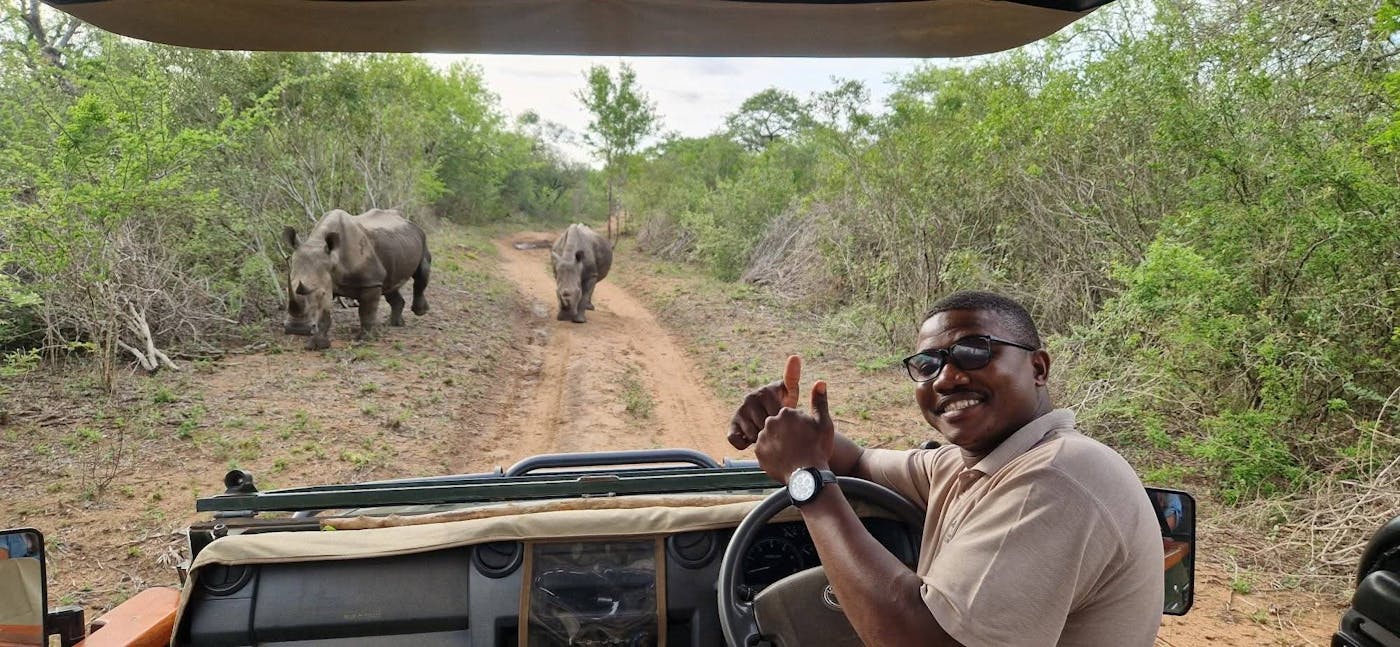
According to field guide Sibusiso Maziya, originally from Siteki, guiding is more than a job; it is a calling.
When visitors arrive at Hlane Royal National Park, often their first connection to the wilderness comes through the words and watchful eyes of a field guide. Tasked with interpreting the bush, telling its stories, and ensuring guests’ safety, these guides are the bridge between people and nature.
According to field guide Sibusiso Maziya, originally from Siteki, guiding is more than a job; it is a calling.
“This is not just a job but a passion-driven career. I really enjoy my office, especially giving the best guided experience and being with like-minded people,” he said.
Maziya has been working with Big Game Parks for three years, previously at Mkhaya Game Reserve in the Siphofaneni corridor, before bringing his expertise to Hlane. His journey into guiding began after high school at Mphundle High School. He later trained at Mlawula Nature Reserve, before completing his Field Guide Association of Southern Africa (FGASA) NQF2 (level 1) qualification at the Campfire Academy in Kruger National Park, South Africa. In addition, he holds a Level 3 Diploma in Eswatini Sign Language, an asset that enables him to communicate with a wider range of visitors. A field guide’s role is often confused with that of a game ranger, yet the two are distinct. A ranger is largely tasked with protecting the reserve’s ecological integrity, engaging in anti-poaching patrols, habitat management, and law enforcement. By contrast, a field guide’s responsibility lies in interpretation and guest experience, taking visitors into the wild and explaining the interconnected web of life that unfolds around them.
Maziya explained that his days were shaped by preparation and guest interaction. “It’s important to prepare yourself before conducting a guided experience, especially to develop a personal connectivity with nature,” he noted. Guests, he said, often want to know what kind of experiences are offered and what makes Hlane different from other reserves in Eswatini. For him, encounters with wildlife are never routine. One memory that stands out vividly with him was an encounter with a bull elephant in musth, a state where testosterone levels are high and moods unpredictable.
“I had an encounter with a musth bull elephant. Luckily, I made it,” he recalled with a smile, his understatement belying the seriousness of the situation. However, beyond adrenaline-fuelled moments, his passion lies in opening visitors’ eyes to the subtle beauty of the bush-bird calls, animal tracks, the meaning of plants, and the often-overlooked details that tell stories of survival. For Maziya, the success of a guided experience is measured not only in wildlife sightings but also in whether visitors leave with a deeper connection to the natural world.
Yet, the work of a field guide today is inseparable from the pressing realities of climate change. “Climate change is a global challenge that has affected many ecosystems,” he explained. “We are experiencing habitat loss, and some species are under threat. Breeding cycles have changed, especially for impalas; rearing of young is not successful due to limited resources.” He added that irregular weather patterns have disrupted long-standing conservation management practices.
“In the past, fire could be used as a management tool to stimulate growth. Now, extreme and unpredictable weather makes this difficult.”
The broader tourism industry is also feeling the effects. Maziya observed that extreme temperatures have reduced tourist numbers in parts of Southern Africa, as many of the region’s visitors come from the northern hemisphere.
“Extreme temperatures have declined tourist statistics since most are from northern Polar Regions,” he said. Despite these challenges, his commitment to the profession remains steadfast. He sees guiding as both a personal and professional growth path.
“It is a career of my choice. It gives individuals a networking opportunity. You grow if a guide enjoys the experience, they will be successful,” he said.
He emphasised that true guiding required dedication, follow-up with guests, and openness to continuous learning.
For visitors, a day spent with a guide like Maziya is not just an excursion but an education. The hope, he said, is that guests depart with a greater appreciation of Eswatini’s natural heritage and a sense of responsibility toward conservation.
“You need to work hard and do follow-ups about guests’ experience in your reserve,” he explained, underscoring his belief that guiding is as much about people as it is about animals.
In the shifting landscape of conservation, where climate change and human pressures reshape ecosystems, the role of field guides has never been more crucial. They are interpreters, storytellers, and educators who ensure that protected areas are not merely visited, but truly understood. For Maziya, guiding is not only about showing wildlife but about cultivating respect, awareness, and care for the fragile balance of nature.